Friday, February 22, 2013

Rabbis Rice: Let Loose on Purim


   This week the Jewish world turns its traditions on their heads. Why? In celebration of Purim; the fun, boisterous holiday that commemorates the foiling of a plot to kill all the Jews of ancient Persia. Its observance comes with its own set of unique and sometimes surprising commandments. One of which is to get drunk. Not just to have a sip or two of wine, but to get so sloshed that you are unable to discern the difference between the names of Purim's hero Mordechai and its villain Haman. You might think that the origin of this practically pagan-sounding ritual is fundamentally hedonistic. However both ancient and modern Jewish sources cite a rather esoteric explanation for drinking on Purim: alcohol sublimates rational thoughts and reduces inhibitions. The advantage of this altered state is that the drinker is truly humbled once they are stripped of their intellectual cynicism. With alcohol in their system, drunken Purim partiers are paradoxically enabled to appreciate that only a higher power can truly discern between good and bad, between Mordechai and Haman. Or so goes the rationale.

     Perhaps this belief is better illustrated by an old parable: a time-honored institution in many Jewish communities is the shadchan, or marriage broker. More than an on-line dating service, he accompanies the deal from its inception all the way to its conclusion. He meets with the respective families, notes their desires, demands and expectations, and presents them with a proposal. He then presides over the negotiations, convincing each side to make the concessions required so that the deal can be closed. Then the boy meets the girl, and the shadchan’s work really begins. The boy wanted someone more beautiful, the girl wanted someone with better prospects. So he explains, cajoles, clarifies, and even exaggerates. (Not unlike a friend who sets you up on a blind date.) More meetings follow, and the engagement is formalized. In the critical months between the engagement and the wedding, the shadchan advises, encourages, assuages doubts, and heads off crises. Then comes the wedding. The bride and groom stand under the wedding canopy, and the shadchan is the proudest man in attendance. At this point, the shadchan is discreetly taken aside and told: "Thank you very much for what you did. Without you, this union could never have been achieved. Now take your commission and get out of our lives. We don’t want to see you ever again."

     In the cosmic marriage between God and Israel, the intellect is the shadchan. Without it, the relationship could not have been realized. But there comes a point at which the shadchan’s brokering is no longer needed, for something much deeper and truer has taken over. At this point, the shadchan’s continued presence is undesirable. Purim is a wedding at which the shadchan has been shown the door. So we are serving drinks! Please note that there are "drunks" who achieve a state of cognitive oblivion, but in no other way do they resemble stereotypical drunks. On Friday night, you will not see them hurling fists, insults, or obscenities at each other, or slobbering over their domestic troubles. Rather you will see outpourings of love. You will experience pure, unbridled joy.

     For 364 days a year, we have no other choice. Our minds must exercise complete control over our emotions and behavior, lest the animal in us rage rampant. We need the mind not only as guardian and regulator, but also as facilitator of our highest potentials. It is the mind that enables us to sustain and improve our lives and imbue the world with the wisdom of Torah. So if the mind does all these things within the finite parameters of reason, it remains the most effective tool we have with which to access the truths of the universe. Still, there is one day in the year in which we enjoy direct, immediate access to these truths. This day is Purim. The Jew who rejoices on Purim has no need for reason. The mind becomes utterly superfluous, something which only encumbers the outpouring of their soul; something which only quantifies and qualifies that which is infinite and all-pervading. So join us, and put your mind to sleep for a few hours. For Purim at Micah is a time of revelry and rejoicing. And for many of us, that will include enjoying a few drinks.

     If you are among those planning to enjoy our festivities this Purim, please remember to drink responsibly and not to drink and drive.

Thursday, February 14, 2013

Happy Valentine's Day!

"Love your neighbor as yourself!"
-Leviticus 19:18

     Love is in the air. Can you feel it? Advertisements are flooding our airwaves for flowers, chocolates, jewelry, and other gifts that have become part of the rituals of the day on our secular calendars dedicated to expressing the emotion we know as affection. "So rabbi, is it okay for me to celebrate Valentine's Day?"
     The correct rabbinic response is that we should celebrate love every day of the year! While it is true that the full name of this holiday was at one time, "St. Valentine's Day," because of its legendary link with the apocryphal story of one of the earliest Christian saints, academics and others have recognized the dubious historical basis of this connection. Even Vatican II, the landmark set of reforms adopted by the Catholic Church in 1969, removed Valentine's Day from the Church's calendar, asserting that "though the memorial of St. Valentine is ancient... apart from his name nothing is known... except that he was buried on the Via Flaminia on 14 February."
     As Reform Jews and advocates of universal celebrations, Valentine's Day is something that people of all faiths may in good conscience observe. It is a day in which to acknowledge the power of love to make us fully human. For at least one famous Talmudic Sage, love represents the ultimate commandment.  For when a non-Jew asked Hillel to, "teach him the entire Torah while standing on one foot," i.e. to summarize its essence, his response was basically the idea implicit in "love your neighbor as yourself." So for some, loving others is the summum bonum of Judaism.
     And yet, the way Valentine's Day is observed leaves out the one person worthy of love who is almost universally ignored.  While a beautiful thing to acknowledge love for another, a closer look at the biblical verse that makes "love" a commandment, points to someone who needs to be loved even before the object of your Valentine's Day passion. The first necessary step to loving others is to love oneself.
     The verse in Leviticus 19:18 reads, "love your neighbor as yourself." There are two instructions given here, and in very specific order. The verse is commonly used to remind us to love others, but we ignore, at our own peril, the first necessary step that has to be taken in order to accomplish the goal of loving others. Love your neighbor, the Bible teaches, as yourself.
     Deep-seated hatred manifested by tyrants or criminals is often in reality self-hatred turned outward. To be truly human, you must begin with self-acceptance and self-esteem. Only then can you move forward to a feeling of affection for others as well.
     The Chasidic Rabbi of Kotzk was right when he witnessed a man beating another and said to his disciples, "See how even while performing an evil act, this Jew fulfills the words of the holy Bible. He demonstrates that he loves his neighbor as much as he loves himself. We can only pray that he eventually comes to love himself, so that he may alter the way he treats others."
    It is not egotistical to make sure that you are likable in your own eyes. According to the Torah, it is a first step we all have to take before we proceed on the journey of love of others that will grant us the greatest fulfillment. So here is our suggestion for Valentine's Day (and as all the other 364 days of the year). Live in a way that earns your deepest respect and admiration, and come share your love of others with us at Micah!

Tuesday, February 12, 2013

Have a Seder, Need a Seder

First Seder, March 25

Every Seder meal begins with the words, “Let all who are hungry come and eat, let all who are in need come and share our Passover meal.” It extends the mitzvah (commandment) of tzedakah (charity) from gifts to physical presence, from giving of our money and possessions to giving of ourselves.

As Passover is traditionally a holy day to be celebrated in the home with family, friends, and strangers, this year Congregation Micah will not be having its Community-Wide Seder. Instead, we are turning back to tradition and encouraging our families to gather around each others’ tables. So how will this continue to be a community event? We are taking the approach of “Have a Seder? Need a Seder?

Are you planning to host a Seder meal at your home? Or were you hoping to attend a traditional Seder as a guest?

Answer these questions, and then call the Micah office and let us know if you are:
  • Willing to host someone at your Seder meal?!
    Please let us know how many you can host and if you would prefer to host a Micah member or anyone from the community-at-large.
  • In need of a place to go?!
    We will work with you to find a family that is opening their Seder meal to others.

Nonmembers will be charged an $18 fee

Friday, February 8, 2013

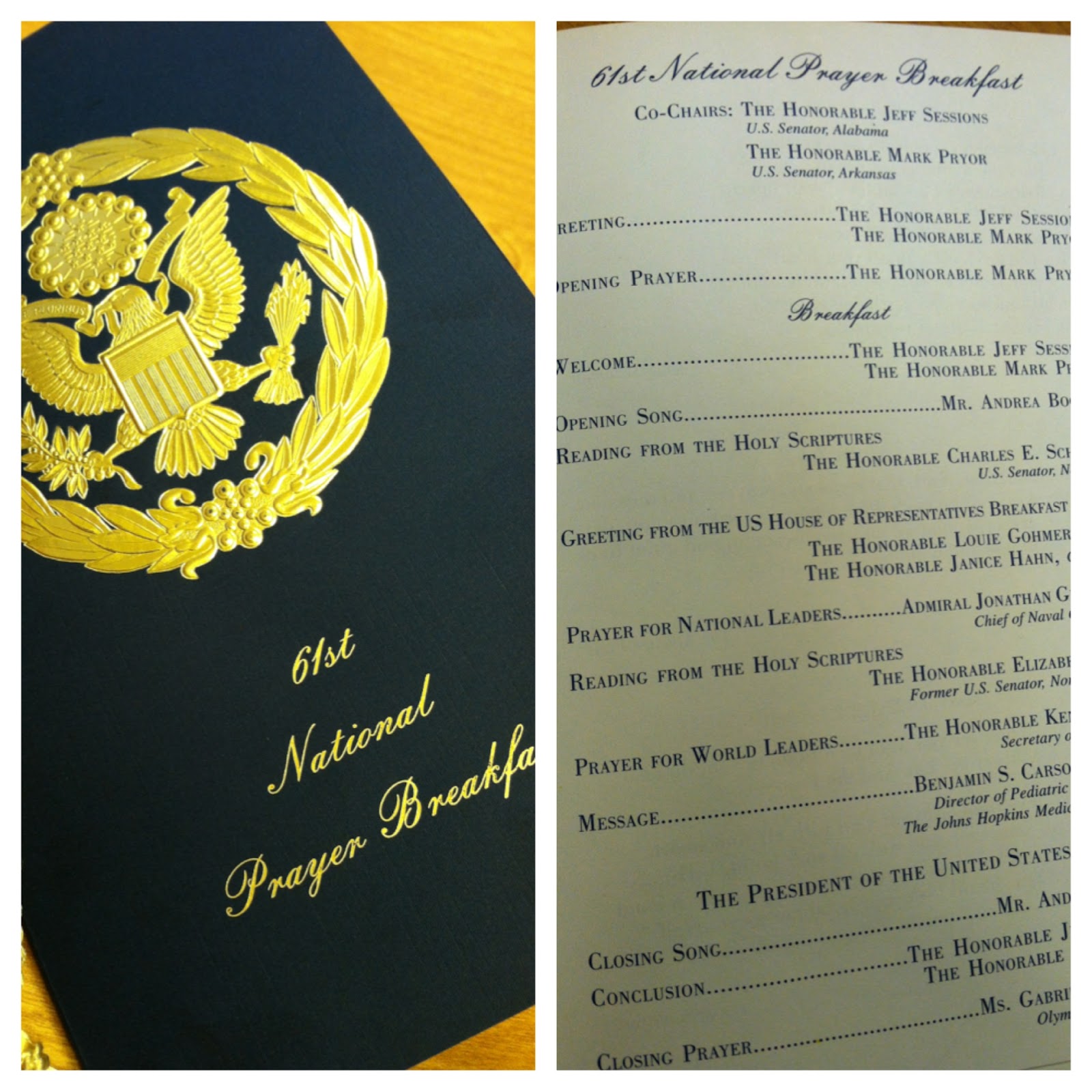
Rabbis Rice: 61st Annual National Prayer Breakfast


"No greater thing could come to our land today than a revival of the spirit of faith - a revival that would sweep through the homes of men and women of all faiths to a reassertion of their belief in God and their dedication to His will for themselves and for their world. I doubt if there is any problem - social, political, or economic - that would not melt away before the fires of such spiritual revival."
-Franklin Delano Roosevelt

Official White House photo by Pete Souza
     It is not everyday that your local Congressional Representative invites you to join him for breakfast with the President. This morning was the 61st Annual National Prayer Breakfast. Founded in 1953 by the United States Senate and House prayer groups, the event unites individuals of various religions, nationalities, and political orientation in the power of prayer. Setting aside these differences to embrace and enhance the moral and spiritual fabric of our lives, this momentous and inspirational gathering reminded me that what unites us all is certainly greater than what divides us! So thank you to Congressman Jim Cooper and his staff for the invitation.
     Highlights of the event included performances by our very own Composer-in-Residence Michael Ochs and his band, My Favorite Enemy, and Italy's Andrea Bocelli. Prayers and scriptural readings were offered by Senators Jeff Sessions, Mark Pryor, Charles Schumer, and former Senator Elizabeth Dole, as well as Congressional leaders, high ranking military officials, and Cabinet members. President Obama spoke about the role faith plays in his life as well as in the life and history of our great nation. Even Olympic Gold Medalist Gabrielle Douglas offered words of inspiration.
     Our Torah portion this week is largely about laws. Our country has laws that protect our free exercise of religion. The entire experience today reminded me of how blessed we are to live in a nation that affords us the rights and opportunities to practice our faith as Jews as we see fit. So take advantage of this privilege! If our national leaders can find the time to pray and live their faiths, so can you...  
Rabbi Flip's program: neurosurgeon and author Ben Carson gave the keynote address
President Obama and Michelle Obama attended the National Prayer Breakfast in Washington on Thursday morning, where they prayed with Senator Jeff Sessions.


Wednesday, January 30, 2013

Rabbis Rice: A Message from Student Rabbi Michael Cohen


      Over 1,200 congregations around the world – both large and small - currently affiliate with Reform Judaism. From the former Soviet Union, Germany and Israel to Australia, Latin America and beyond, Jews are experiencing an awakening or a rebirth of congregational activity on new and unparalleled levels. With an estimated 1.8 million members in 45 countries, the liberal streams of Judaism now represent a global community with diverse practices and yet similar goals: to build a contemporary, creative expression of Jewish spiritual and cultural identity around the world that is rooted in our rich Jewish traditions.
       Like Congregation Micah, Progressive Judaism is rooted in the Torah, especially the teachings of the Hebrew Prophets. It is founded on authentic manifestations of Jewish creativity, ancient and modern, which stress inwardness and desire to learn what God expects from us:  justice and equality, democracy and peace, personal fulfillment and collective obligations. The practices of Progressive Judaism are anchored in Jewish thought and tradition. They seek to extend the range of observance by granting full equality to all Jews, irrespective of gender and sexual orientation, while challenging laws that are contrary to Judaism's fundamental principles.
       Of the 12 million Jews in the world today, nearly one-third still live in countries where Jewish life is weak and where there are few opportunities for meaningful Jewish practice. It is the goal of the World Union for Progressive Judaism to ensure that all Jews have access to the vibrant Jewish life that can best inspire them spiritually and bring their communities together practically. We at Micah are also committed to this sacred task. Under the tutelage of Rabbi Ken Kanter several members of Congregation Micah have gone on to become rabbis. This list includes Rabbi Nicole Roberts, who will be installed as rabbi of North Shore Temple Emanuel in Australia next month and Student Rabbi Noah Scacciaferro who is studying in Cincinnati.  Student Rabbi Michael Cohen, who began his studies in Jerusalem this past year, was there at Micah’s founding in 1992.  He is a former Confirmand whose father rests peacefully in our cemetery, and he writes to you from Israel (below) on behalf of the Jews of the Former Soviet Union.

       Shalom from Jerusalem!  I am halfway into my first year of rabbinical school at Hebrew Union College. From witnessing the conflict between Hamas and Israel to the recent elections, this has been a truly eventful and experiential year. I eagerly look forward to sharing my stories with you all when I spend some time at Micah this summer shadowing the Rabbis Rice. It’s been a very long time since I was home in Nashville for an entire summer.  After graduating from Brentwood High School in 2003, I went on to study at Brandeis University. Then I joined the United States Army where I served for the last five years.  In that time, I deployed to Haiti, Kuwait, Qatar, and Afghanistan.  As of May 2012, I switched into the US Army Chaplain Corps and moved to Jerusalem for my first year of rabbinical school.  Following in the footsteps of several Micah members who came before me, I would not be on this path without the support and Jewish education that I received growing up at Micah and the guidance of all of my teachers including Rabbis Ken Kanter, Philip and Laurie Rice. I am forever grateful.
       This Passover I will be traveling to the Former Soviet Union (FSU) to lead a Seder as well as teach Jewish education classes. The FSU Pesach Project brings students from Hebrew Union College together with Jewish communities of the Former Soviet Union (FSU) to celebrate Passover. This project was created in response to a call from FSU Jewish communities with insufficient access to progressive Jewish experiences. In close partnership with the World Union of Progressive Judaism (WUPJ), the FSU Pesach Project has seen 10 years of success. Last year's project enabled nearly 5500 people in Russia, Belarus, and the Ukraine to come around Seder tables together in celebration. Every Jew, regardless of where they grew up, deserves a Jewish experience that resonates with their values.
       In order to achieve this goal, each student needs to personally raise $2500 through tax deductible contributions.  As such, I am asking the Micah community for assistance in this effort.  For many of the people I will have the privilege of teaching and learning from, this will be their first formal Jewish experience. So I/we need your help.  Please visit the following website to help bring Passover to those who have never experienced it.  http://fsupesachproject2013.wordpress.com Thank you, and I look forward to seeing all of you this summer!    - Michael G Cohen

Thursday, January 24, 2013

Let Silence Speak


“All of my life I was privileged to be in the company of the wise people of Torah and I learned from them that nothing is more valuable to productive living than silence.”
                                                                                                                                                                                                                Rabban Gamliel

                One of the hallmarks of modern life is constant noise: the construction across the street, the never-ending roar of traffic, the incessant ringing of the telephone, the radio and its constant programming - they all make for a great deal of a relentless racket that surrounds us.  And then there is the problem of never-ending conversation, the need for others (our children, friends, co-workers, parents, etc.) to express themselves to you constantly.  Quiet and silence have almost become extinct.  The rabbis and sages of the Talmud valued silence as a vital factor in life. The Talmud stated that a good word is worth one shekel but that silence itself is worth two. The holy men of Israel advanced the idea that penance for sin can be achieved not only by fasting from eating food but more beneficially by fasting from speaking – by silence and its mood inducing power of self-analysis and introspection.
                So while speech in Judaism is the ultimate gift from God and what separates us from other forms of life on this planet, it was given to us to be used sparingly and purposefully.  Among the many great and satisfying aspects of Shabbat is its silence.  Especially in our world of constant noise, the silence of Shabbat is refreshing and invigorating.  Freedom from the noises of telephones, radios, television sets, construction and traffic as well is a blessing to a noise-laden weary soul.  And it is in the silence of Shabbat that we can gain new insights into the words of the Torah that God, “so to speak” is found not in the noise generated by the wind or the sound of the mighty earthquake but rather “in a still, small, silent voice.”  Consider how difficult it is to make peace with adversaries.  How much harder then, if one cannot make peace with one’s self.  As long as there is an absence of an atmosphere of silence and quiet, making peace with one’s self is impossible.  Enter Sheket Shabbat, the Silent Sabbath.  This Saturday morning Congregation Micah will welcome in the quiet of the Shabbat by creating an atmosphere of serenity. Join us at 10:30 for a service followed by a day of quiet.  There will be opportunities to read, practice yoga, or engage in a variety of inaudible activities.